

1.Bank Guarantee (BG): The need for Change
- Invocation of a BG: The year was 2017 and I was heading the Industrial Finance Branch of SBI in Chennai. One day as I was entering the branch in the morning I saw a person, who I did not seem to have met earlier. He seemed to have been waiting for the branch to open and was apparently in visible stress. I was told that he was representative of a beneficiary, and he had come in person from Delhi to lodge the invocation of the BG along with the original BG document is issued on a stamp paper and for the beneficiary it is an important document as in the absence of the original, it would be difficult to invoke the BG. Moreover, it is also important to lodge the invocation along with the BG at an early date as in case of any delay there is always a possibility that the applicant can seek intervention of the Courts and obtain a stay on invocation of the BG. So, it was not uncommon for a beneficiary to go in person to invoke the same to avoid risk of delays or loss of the BG document in transit.
- Procuring the stamps required for the BG: During my tenure at another branch in SBI, I got a call from a customer who wanted a BG urgently. As it was a small branch, we did not have the stamp paper of the requisite denomination at the branch and when we approached the stamp vendors, they had closed for the day. The BG could only be issued the next day when the stamp vendors opened for business.
- Managing the Contingent Liability: The contingent liability in respect of bank guarantee was also a challenge for the bank as many times the original guarantees were not received at the branch even after the expiry of validity of the BG and in the absence of the original BG, there was a possibility that an invocation could come at a later date through post with the original bank guarantee. Later banks came out with instructions that the liability would be marked off after giving a notice and a timeline to the beneficiary. A contingent liability which extends beyond the validity of the BG is a cost to the bank as fee is recovered only for the period of validity of guarantee. It also causes inconvenience to the applicant as credit limits are blocked.
- Ascertaining authenticity of a BG: The biggest risk for the beneficiary is that the BG submitted by the applicant may not be genuine. The beneficiary would often seek independent confirmation from the opening bank regarding issuance of the BGs. In respect of high value BGs the beneficiary would often send a representative in person to the branch which had issued the BG to mitigate the risk of a fraudster intercepting the letter and sending a communication on behalf of the bank. This risk was substantially mitigated when it was decided that the issuing a branch would send a confirmation by SFMS to the beneficiary’s bank. However, in respect of every BG, the beneficiary would have to follow up with his bankers to obtain the confirmation, even though he might have the actual BG with him. This can lead delays and inconvenience to all concerned. The SFMS system was not always fool proof as it was only a message regarding issuance of the BG and may provide an alert about manipulation of the contents of the BG.
- Managing stock of BGs: The other challenge for the beneficiary was to manage the inventory of physical BGs so that invocation of BGs or the request for renewal of BGs was done well before the date by lodging it with the issuing bank. In case of amendment or extension of validity of BGs the same process especially regarding seeking confirmation of the instrument, was followed like in the case of the issuance of BGs.
“The other challenge for the beneficiary was to manage the inventory of physical BGs so that invocation of BGs or the request for renewal of BGs was done well before the date.”
2. Electronic Bank Guarantee (e-BG): The Way forward
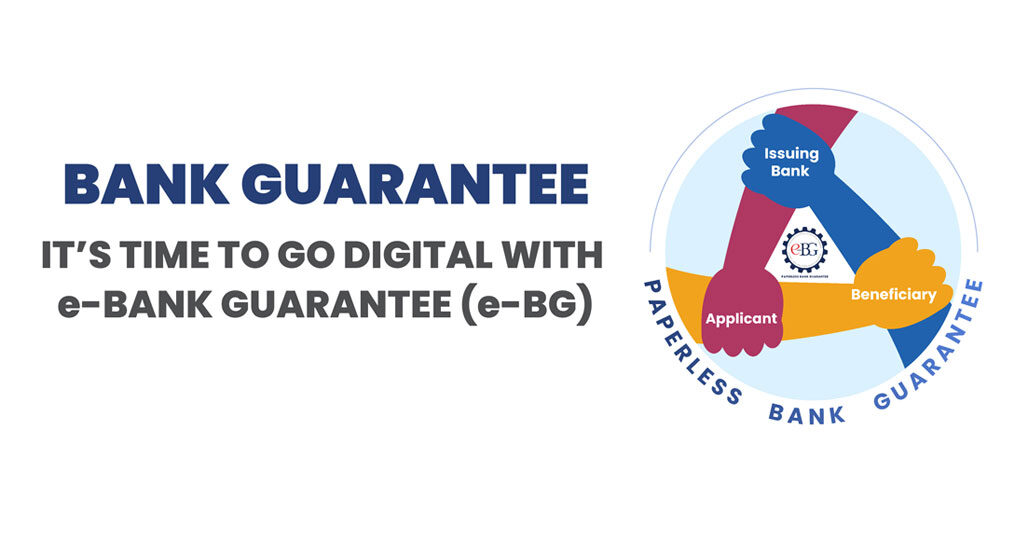
- Fully Digital process: In the e-BG the issuance, amendment, invocation and the cancellation of the BG are done online in fully digital mode with a valid digital signature, through the DDE (Digital Document Execution) platform of NeSL (National E-Governance Services Limited). This is made possible through an integration of the banks accounting system with the NeSL DDE platform. NeSL has also integrated with various state governments for seamless and real time procurement of stamp duty and affixation with the BG document which can be subsequently signed through the Aadhaar e-sign or through a dongle based Digital Signature Certificate (DSC) on the NeSL portal. There is a facility for “server-based signing”, where banks can fully automate the signing process. This is suitable for centralised process of issuance of BGs and there is no dependency on the presence of the authorised signatory. The duly stamped and executed BG is instantaneously available on the NeSL DDE platform. The beneficiary has to do a onetime registration and access the BG on the NeSL platform.
- Convenience for the Beneficiary: The process of verification of the BG document becomes seamless, immediate and fool proof. A notification is sent regarding the issuance of the BG as also any change in status of BG like amendment, extension of validity date. The beneficiary can easily access outstanding BGs in its favour, there is also a search facility on the NeSL portal. The e-BG platform can also be customised to generate reports as desired by the beneficiary like alerts for BGs becoming due for renewal.
- Benefits for the Applicant: The applicant benefits from an e-BG as the BG becomes effective almost immediately, credit limits get released quickly on release of BGs, contract implementation happens without delays associated in physical verification of BGs and in general “ease of doing business” is facilitated.
- NeSL as a central repository: NeSL, as an Information Utility (IU) can accept and store electronic submission of financial information in the manner provided in the Insolvency and Bankruptcy Code (IBC). Financial information includes debt and liabilities and also includes contingent liabilities like bank guarantee. Accordingly, NeSL can serve as a central reservoir of BGs. This can be accessed by authorised persons based on their need. For example, statutory auditors of the company can use this for external confirmation of contingent liabilities and other debt. On commencement of insolvency, the IP can access the same to arrive at the debt and liabilities including contingent liabilities of the corporate debtor.
3. NeSL: A regulated entity
- National E-Governance Services Limited (NeSL) is an Information Utility regulated by IBBI. As a regulated entity NeSL has some obligations under the law. The law provides that NeSL shall have a Compliance Officer appointed by the Board of Directors who reports independently to the Regulator. The e-BG product is an extension of our DDE product. An e-BG is executed on our platform as the provisions of the Information Technology Act, the principal law governing digital document execution. For example, mortgages are not permitted. Secondly, as stamp duty comes under the purview of the state governments, approval for issuance of bank guarantee should have been permitted by the State Government under the Stamp Act of the state. Most states have facilitated the execution of documents including e-BG through the DDE platform.
“Almost 20% of DDE transactions happen on nonbusiness hours and holidays, while our analysis shows that in every hour of the day or night some DDE transactions are being executed.”
- Security Features of DDE: Users of the DDE have the comfort of dealing with an entity like NeSL which is regulated by IBBI and which also conducts an annual inspection of NeSL. The law also provides for an audit of the information technology framework, interface and data processing systems of NeSL every year by an external agency. NeSL also has a Technology Committee comprising of eminent persons to advise on technology related matters besides a Chief Technology Officer (CTO) and Chief Information Security Officer (CISO) who have overall responsibility for technology and information security respectively. The security framework of NeSL is compliant with ISO 27001:2013 requirements and also adheres to the RBI guidelines on Cyber security framework. Data Security & Privacy is ensured in all applications and processes. The data is stored in Tier 4 Data center with the Primary, and the Disaster Recovery Centers located in different seismic zones. Accordingly, issues relating to technology and information security are given prime importance.
4. Conclusion
NeSL’s DDE platform has seen more than 8 lac transactions within a short span of two years. It’s product agnostic and can be used across all customer segments. While the most common usage in the individual segment is for personal loans, but it has also been used for vehicle loans, and education loans. In the business segment it has been used for working capital, term Loans, Emergency Credit Line Guarantee Scheme (ECLGS) and others. The amount of loans could vary from the smallest of loans under government schemes to large corporate loans of a few thousand crores. Almost 20% of DDE transactions happen on non-business hours and holidays, while our analysis shows that in every hour of the day or night some DDE transactions are being executed. The same success can be achieved for e-BG. With the trade finance being increasingly automated by banks, I can foresee a day when a customer can get a BG issued sitting in the comfort of his office or home at any time of the day and the beneficiary being able to access the e-BG in a secure manner almost instantaneously.