

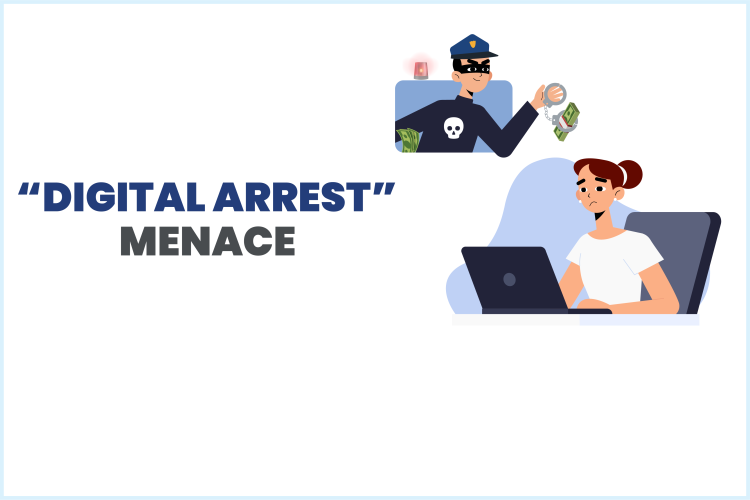
In the present day of highly connected digital world, the cyber threats are also equally evolving and are now super powered with the possibilities of AI & ML. This also makes room for fraudsters to enhance their winning possibilities in various scams. Even though the word “Digital arrest” is there in the air associated with various fraudulent activities, still the number of citizens getting prey to such scams are on the rise. As per media reports, more than 200 cases are reported in National Capital Region (NCR) alone in a month. A “Digital Arrest” scam involves fraudsters impersonating law enforcement via video calls, threatening fake arrests to extort money.
In majority of the cases, the scam starts with a simple phone call claimed to be from any courier company, any Mobile service provider, Telecom department or any Bank. The calls may be a direct call or a recorded message with a request to enter any number to get further details. The call gets connected to a human claiming to be a support person and the trauma starts there. The fraudsters in many case might have collected some of the information about you, such as Aadhaar (or probably the last 4 digits), PAN, Bank details etc. With such information, you will be made to believe that your Aadhaar, PAN, Mobile or Bank account has been used for illegal activities. Afterwards, the victim is connected to impersonate officials in the uniform of law enforcement agencies, such as Police, Customs, ED, CBI etc where interrogation over video conferencing and issues an arrest warrant over the call or through WhatsApp. Digital Arrest involves the virtual restraint of individuals, which includes restricted access to the accounts, and digital platforms, prevention of any digital activities, live monitoring through video call, periodic attendance reporting on the call and continues till the scammers could extract the money from the victim. Typical mode of Operandi is to issue an arrest take the victim to a virtual court on a Skype call while in “Digital arrest”. The victim is made to believe that the account balance in the banks to be transferred to a bank account, which will be verified and returned in a maximum of 30 minutes. Letters in fake letterheads of various authorities shall be issued and on transfer of accounts, receipt also will be issued on similar stationary.
The scammers are capitalising on the ignorance, fear, anxieties or blind trust of their target and with the kind of mental trauma, the victim loses their ability to think and act. In a recent incident with the Chairman and Managing Director of a leading textile group in India, he was defrauded by a group posing as officials from various government agencies and they also took him to a virtual court, where the impersonalised Chief Justice of India (CJI) was hearing the case.
In view of the increased incidents, Indian Cyber Crime Coordination Centre (I4C), affiliated to the Ministry of Home Affairs released an advisory, which says “Don’t Panic, Stay Alert. CBI/Police/Custom/ED/Judges DO NOT arrest you on video call”. Various courier agencies have also issued guidelines to stay away from the fraudsters. The FedEx issued the below given alert in detail on such activities.
FedEx does not request, via unsolicited call, mail, text or email, payment or personal information in return for goods in transit or in FedEx custody. If you receive any of these or similar communications, do not reply or cooperate with the sender.
FedEx is not associated, affiliated with or authorized to act on behalf of any national/local law enforcement authorities.
If any individual, on the pretext of being a FedEx customer care team member is directing/ connecting you with any fake national/local law enforcement authorities in respect of any shipment containing illegal items in your name, do not share any personal information. If your interaction with such requests resulted in financial loss, report immediately by calling 1930 or www.cybercrime.gov.in
Even after various news articles and awareness messages from various agencies, there is no end to such fraudulent “Digital Arrests” and extortion of money. The only way to stay away from being victim to such scams is to stay vigilant, have an open discussion with your friends and colleagues or take support of information security team in case of any doubts. As a preventive measure, the government has launched the Chakshu portal ( https://sancharsaathi.gov.in/sfc/Home/sfc-complaint.jsp ) recently under the Sanchar Sathi initiative of the Department of Telecom. Chakshu facilitates citizens to report the suspected fraud communications with the intention of defrauding telecom service users for cyber-crime, financial frauds, non-bonafide purpose like impersonation or any other misuse through Call, SMS or WhatsApp. In case of getting victim to any of the cybercrime, the complaints to be registered in the National Cybercrime Reporting Portal (NCRP) at https://cybercrime.gov.in. The financial cyber frauds to be reported by calling the National Cybercrime Helpline number 1930
-by Jyothish Jolisa
VP (Information Security) & CISO