

The pandemic has accelerated digital technology in the financial sector and impacted the role of financial technology firms. Among the revolutionary financial technology solutions are contactless lending, paperless lending, mobile banking, secure payment gateways, mobile wallets, and retail stock trading. India’s largest population is spread in the rural countryside and digital technology solutions will lead the way for Financial Services to reach the remote corners of the country offering access to digital banking and financial services.
One such innovation that stands out is the Digital Document Execution (DDE) platform, a platform devised under the Information Utility regulated by Insolvency and Bankruptcy Broad of India (IBBI).
Digital Document Execution
DDE is a mode for paperless execution and storage of financial contracts, which will result in superior enforcement, thereby enhancing the ‘Ease of Doing Business’ especially in times where quick financing is the need of the hour for businesses. The concept was formulated under the guidance of the Ministry of Finance and IBBI for NeSL to serve the financial sector in facilitating dematerialization of loan contracts
DDE’s key objectives were as follows
- Dematerialization of the document execution and customer acquisition transactions.
- Online stamp duty payment and receipt of digital stamp certificate
- Optimization of financial and human resources on account of adoption of paperless green processes
- Support information for loan exchange platform, secondary loan market etc
- Serve as a repository for digitally executed loan documents
- Offered as a service to lending institutions: DDE offers convenience, time in cost savings due to resource utilisations and offers wide reach.
Breaking New Ground
In its initial phase, the DDE solution was a novel concept, marking a departure from traditional paper based financial practices. Union Bank of India was the first bank to execute a DDE transaction in 2020.
Today DDE platform is being used by 35 of India’s TOP Banks and Financial Institutions across various departments including 110 implementations. The aggregate of state governments to issue digital e-stamping to NeSL has reached 26 now with the 1st state being Rajasthan in the year 30-12-2020.
Reaching the First Million
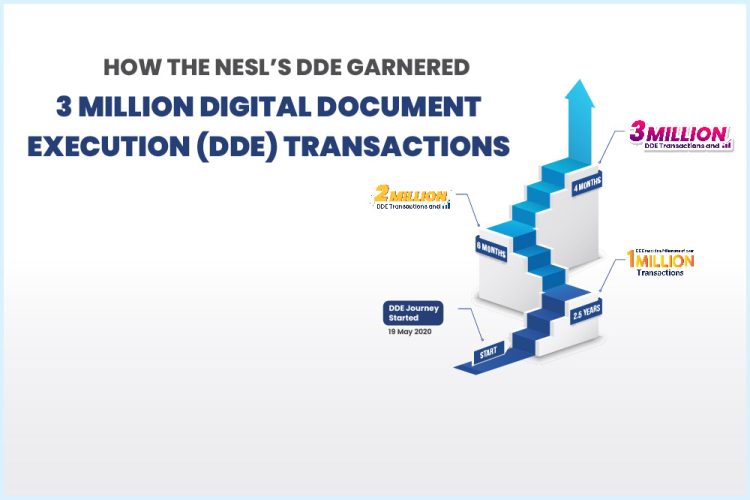
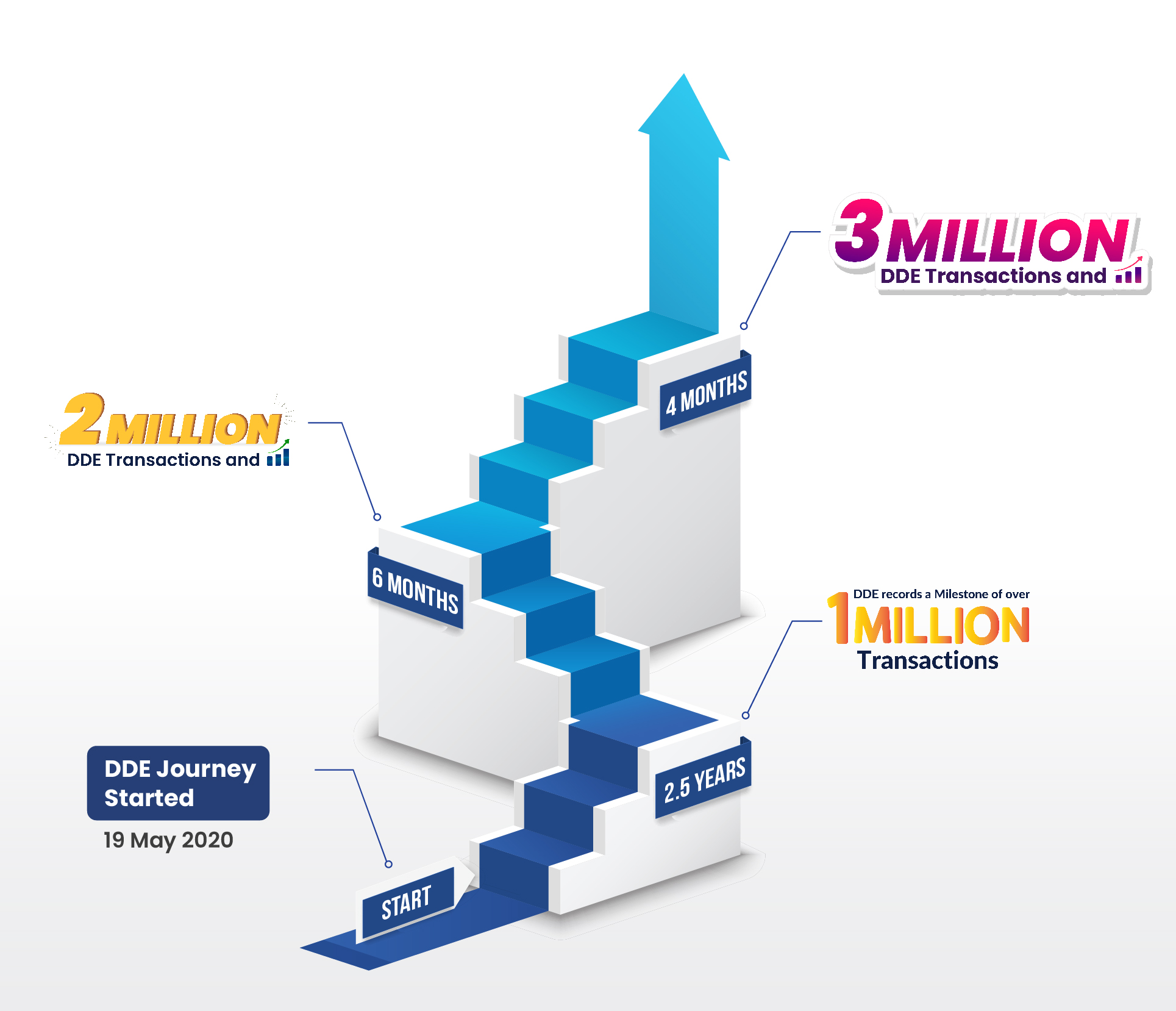
The platform continued to gain traction due to the immense benefits it offered. With the promise of quick, seamless, and error-free transactions, financial institutions began to take note. On 16th November 2022, the platform celebrated a significant milestone of processing 1 million DDE transactions in 2.5 years.
The Road to 3 Million
The DDE platform did not rest on its laurels. It continued its stride, doubling its transactions in a relatively shorter time. The platform reached an unprecedented 2 million transactions by 22nd May 2023, just 6 months after reaching its first million. By 14th September 2023, just under 4 months, it reached the 3 Millionth DDE Transaction. This speedy growth rate was a testament to the platform’s value and its increasing acceptance among banks, other financial institutions and end users across the nation.
Reasons for Rapid Adoption
Several factors have contributed to the platform’s rapid growth. The utilization of digital E-stamping and E-signing technologies has made the process of financial contract execution more efficient. It also offers a high level of authenticity and transparency, leading to its popularity among various stakeholders. Below are some of the Key Initiatives that led to the success of DDE
- The Morgan Stanley report* on India cites the strides the GoI has taken in digitising the economy through initiatives like Aadhar and UPI. Aadhar leads the way for digital signing and authentication.
- The increasing acceptance of digital documentation by banks and FIs
- The rapid pace of integrating e-stamp services from 24 state governments on the NeSL platform.
- Processing JanSamarth loan agreements digitally: a national initiative offering government loans and financial aid directly to rural farmers through public and private banks was initiated through DDE on NeSL.
Among the key benefits that lead to the pace of adoption of DDE are: convenience of executing digital documents, elimination of physical document storage, significant resource cost, ability to execute anytime and anywhere and time savings have been particularly attractive to institutions and individuals looking to cut costs and enhance operational efficiency.
In just three years, the DDE platform’s extraordinary achievement signifies the power and potential of digital technologies in revolutionizing the financial landscape. With continuous support from the government and growing trust from the financial sector, the DDE platform is set to change the face of financial transactions in India, making financial services more transparent, efficient, and accessible.
NeSL thanks our regulator IBBI, State Governments, IBA, Banks and Non-Banking Financial Institutions for advocating the need for a digital way to document, stamp, authenticate, store and access financial documents.
*Source – Morgan Stanley Report