

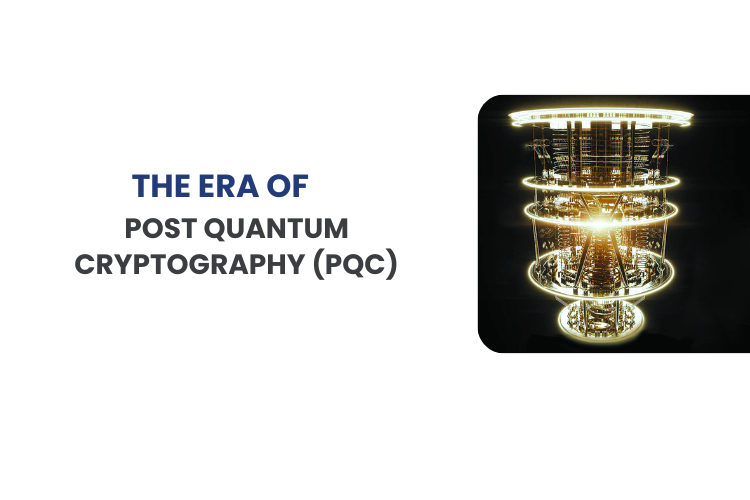
In today’s digital age, where electronic communications are the backbone of our day-to-day interactions, encryption has become a very crucial and critical element to ensure the security and privacy of the information in-transit as well as at-rest. However, with the advent of technologies such as Artificial Intelligence/Deep learning, the offenders are also equally reaping the benefits, with highly powered computing systems loaded with GPU. The entry of Quantum computing into the mainstream, even though not yet directly integrated into the cryptographic process, the concerns shoot multifold. The community which strives to protect our data in the cyberspace has responded and reacted to tackle the new anticipated menace, leading to the concept of Post Quantum Cryptography (PQC).
In the beginning of 1900s, the research on Quantum physics started, which is a fundamental physics theory that describes the physical properties of nature at the scale of atoms and subatomic particles. These researchers’ study on how all the functions happen at its most basic level has created a base for all the latest research and developments in Quantum computing, Quantum communications, Quantum sensors etc. These fundamentals of physics listed above are employed in “Quantum computing” in the calculations to solve extremely complex problems very quickly. The quantum computing is built on the concept of “Quantum bits” or “Qubits”, which can represent any combination of both Zero and One simultaneously in contract to storing either a Zero or a One in the classical computing in the form of bit. While the qubits are in this superposition, each subatomic particle can interact and influence others, which is termed as quantum interference and can explore many paths in parallel. In addition, qubits can interact with each other and scale exponentially, which is termed in Quantum computing as “entanglement”. This exponential scaling gives quantum computers much more power than classical computers. All these characteristics form part of Quantum hardware chips that store qubits, giving an extraordinary computing power to the system.
The data encrypted today using any strong traditional encryption methods could be intercepted and decrypted by adversaries in future once they have access to powerful quantum computers. It may be noted that cryptographically relevant powerful quantum computers are not existing as on date but is predicted to emerge in another 10 years. The adversaries even collect encrypted data so that they can decrypt those later using quantum computers, becomes available to such people. This concept by such adversaries is called “harvest now, decrypt later” and emphasizes on the need for Post Quantum Cryptography (PQC).
New algorithms that are resistant to any decryption attempts even by a super powered supercomputer is termed as Post Quantum Cryptography (PQC). PQC will replace the current encryption schemes such as Advanced Encryption Standard (AES), Rivest-Shamir-Adleman (RSA), and Triple Data Encryption Standard (Triple DES), Elliptic-curve cryptography (ECC) etc. Various research in academia and R&D institutions across the globe are in progress in this domain. In communication, Quantum Key Distribution (QKD) is employed that utilizes quantum mechanics to create a shared secret key. QKD relies on the laws of physics rather than mathematical algorithms used in current methods. This makes QKD resistant to any attacks powered by quantum computers. While quantum cryptography is based on laws of physics, PQC is concentrating on hard mathematical problems. National Institute of Standards and Technology (NIST), a division of the U.S. Department of Commerce has already released three standards in PQC, designed for general encryption and digital signatures. FIPS 203, FIPS 204 and FIPS 205, which specify algorithms derived from CRYSTALS-Dilithium, CRYSTALS-KYBER and SPHINCS+, were published August 2024.
Recently India’s achievement in the new quantum era was in the news (June 2025) by successfully demonstrating an experimental advancement through free-space quantum secure communication using quantum entanglement over a distance of more than one km was achieved via a free-space optical link established on the IIT Delhi campus. Earlier, India’s first intercity quantum communication link between Vindhyachal and Prayagraj in 2022, using commercial-grade underground dark optical fiber was demonstrated. In 2024, the team successfully distributed quantum keys using entanglement over a 100 km spool of telecom-grade optical fiber in another DRDO-supported project.
Quantum computers of future will have the potential to break any strong public key cryptography standards used today, posing a direct threat to security of data which is protected today. The consequences are beyond imagination and will impact all industries. It is a direct threat to Critical Information Infrastructures (CII) and overall national security. This necessitates proactive and rapid transition to quantum-resistant cryptographic solutions.
-by Jyothish Jolisa
VP (Information Security) & CISO